RTX 5090 vs H100 for local AI in 2026
80 GB HBM3 datacenter card; the GPU GPT-4 was trained on.
- VRAM
- 80 GB
- Bandwidth
- 2000 GB/s
- TDP
- 350 W
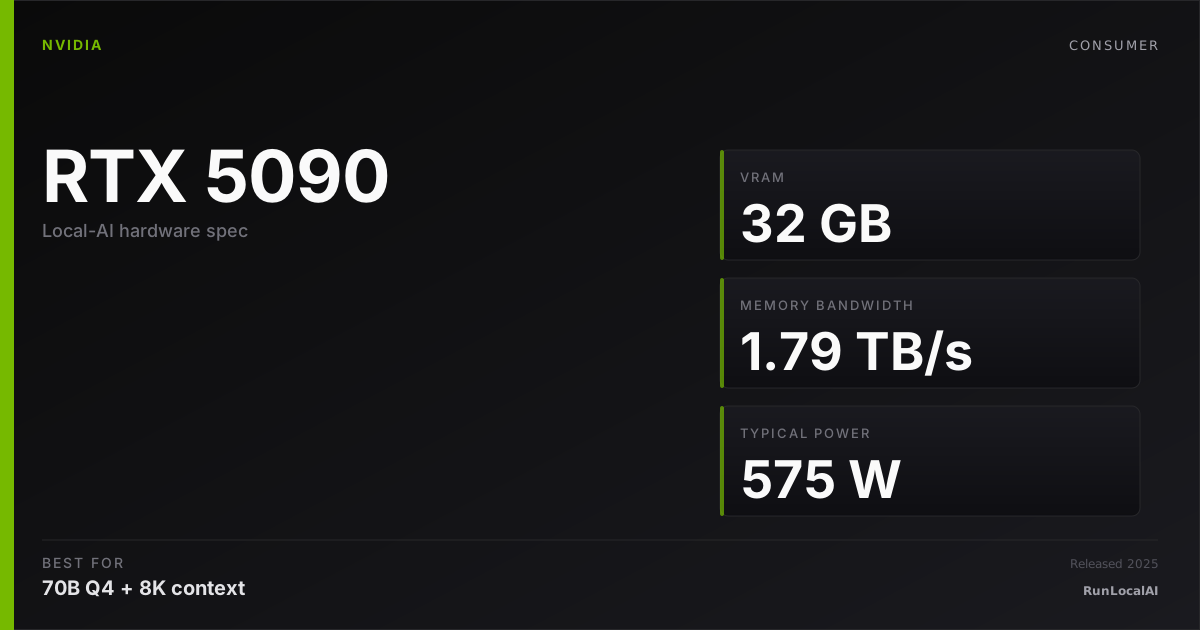
RTX 5090
32 GB GDDR7 flagship; Blackwell consumer.
NVIDIA H100 PCIe (datacenter)
80 GB HBM3 datacenter card; the GPU GPT-4 was trained on.
This is a real question now: scaling local AI past the 32 GB consumer ceiling means either dual-5090s, an Apple Silicon Mac Studio, or stepping into datacenter silicon. The H100 PCIe is the gateway — 80 GB HBM3, 2 TB/s bandwidth, FP8 native support.
Cloud rentability flips the math entirely. An H100 costs $2-4/hr on Lambda / RunPod. If you'd use it under 200 hours/month, renting beats buying. Owning only wins when utilization is sustained and the egress cost (data privacy, VPC requirements, latency) makes cloud infeasible.
Memory planning: RTX 5090 — 32 GB nominal memory: check 32B Q4. Reserve space for KV cache and runtime; offload is a separate configuration. NVIDIA H100 PCIe (datacenter) — 80 GB nominal memory: check 70B Q4 with a checked context budget. Reserve space for KV cache and runtime; offload is a separate configuration.
Who wins each workload
Each row is a workload local-AI operators actually run. Verdicts derived from VRAM math + bandwidth — no editorial hand-wave.
What each card actually runs
VRAM math against a canonical set of popular models. The largest context window that fits with headroom appears in each cell.
| Model | RTX 5090 | NVIDIA H100 PCIe (datacenter) |
|---|---|---|
Qwen 3 14B Q4_K_M 14B params · Q4_K_M | 32K ctx | 32K ctx |
Qwen 3 32B Q4_K_M 32B params · Q4_K_M | 16K ctx | 16K ctx |
Llama 3.3 70B Q4_K_M 70B params · Q4_K_M | OOM | 16K ctx |
DeepSeek R1 distill 32B 32B params · Q4_K_M | 16K ctx | 16K ctx |
Mixtral 8x22B Q4 141B params · Q4_K_M | OOM | OOM |
FLUX.1 image gen 12B params · FP16 | 1 | 1 |
Fit figures are estimates. We have removed throughput and cost rankings without matched measurements. Compare model, quantization, context and runtime in the benchmark records. Price ranges are editorial estimates, not live merchant quotes.
Quick decision rules
Operational matrix
| Dimension | RTX 5090 32 GB GDDR7 flagship; Blackwell consumer. | NVIDIA H100 PCIe (datacenter) 80 GB HBM3 datacenter card; the GPU GPT-4 was trained on. |
|---|---|---|
VRAM The dimension that decides FP16 70B+ viability. | — 32 GB nominal memory: check 32B Q4. Reserve space for KV cache and runtime; offload is a separate configuration. | — 80 GB nominal memory: check 70B Q4 with a checked context budget. Reserve space for KV cache and runtime; offload is a separate configuration. |
Memory bandwidth Higher = faster decode. | Excellent 1.79 TB/s GDDR7. Best consumer bandwidth in 2026. | Excellent 2.0 TB/s HBM3. ~12% faster — H100 SXM is 3.35 TB/s. |
FP8 native support Modern training + inference workflow. | Strong FP8 supported (Blackwell consumer). Some kernels not as mature as Hopper. | Excellent FP8 first-class — Hopper introduced FP8 training. Reference implementation. |
Price (2026) Realistic acquisition cost. | Strong $2,000-2,500 retail. ~10x cheaper than H100. | Limited $22,000-30,000 datacenter market. Cloud rental ~$2-4/hr makes ownership only sensible at sustained utilization. |
Power draw Sustained-load wall-power. | Limited 575W TDP. Needs 1000W+ PSU. Tight ATX builds struggle. | Acceptable 350W. Saner power than 5090; designed for dense multi-GPU servers. |
Form factor Where it physically fits. | Limited 4-slot reference cooler. Multi-GPU often impractical in consumer cases. | Strong 2-slot dual-width passive. Designed for server chassis with directed airflow. |
Software stack Runtime + framework support. | Strong All consumer runtimes work. vLLM, TensorRT-LLM, llama.cpp, ExLlamaV2. | Excellent Reference platform for vLLM / TensorRT-LLM / DeepSpeed. Every paper validates against it. |
Cloud rentability Pay-per-hour alternative to buying. | Limited Sparse on cloud providers. Mostly bare-metal rentals if at all. | Excellent Lambda, RunPod, Vast.ai, AWS — all stock H100. $2-4/hr typical. |
Tiers are qualitative editorial labels, not derived from a single benchmark. Price and cost rows are editorial estimate ranges for the year stated, not live prices. For tok/s and VRAM measurements on these cards, browse the corpus or request a benchmark.
Who should AVOID each option
Avoid the RTX 5090
- If sustained 24/7 inference / training is the workload
- If on-prem / VPC privacy is mandatory and budget allows H100
Avoid the NVIDIA H100 PCIe (datacenter)
- If your workload is quantized 70B Q4 inference (32 GB plenty)
- If your utilization is < 200 hours/month (rent instead)
- If you don't have a server chassis with directed airflow
Workload fit
RTX 5090 fits
- Single-card homelab maximum
NVIDIA H100 PCIe (datacenter) fits
- Sustained 24/7 inference at scale
- On-prem regulatory compliance workloads
Where to buy
Where to buy RTX 5090
Prices move. Check the current price at the retailer before you buy.
Where to buy NVIDIA H100 PCIe (datacenter)
Prices move. Check the current price at the retailer before you buy.
Affiliate links — no extra cost. We don't quote live prices here. Check the current price at the retailer before you buy.
Some links above are affiliate links. We may earn a commission at no extra cost to you. How we make money.
Editorial verdict
If you genuinely need H100 capability but utilization is bursty, rent. Lambda + RunPod ship reliable H100 instances at $2-4/hr. 100 hours of rental costs $200-400 — that's 1-2% of buying. Owning only pencils out at sustained 24/7 utilization on a job that can't run on cheaper hardware.
HonestyWhy benchmark numbers on this page might not reflect your real experience
- tok/s is not user experience. Humans read at ~10-15 tok/s — anything above that is buffer time, not perceived speed.
- Context length changes everything. A 70B Q4 model at 1024 tokens generates ~25 tok/s; the same model at 32K context drops to ~8-12 tok/s as KV cache fills.
- Quantization changes the conclusion. Q4_K_M vs Q5_K_M vs Q8 produce different speed AND different quality. A benchmark at one quant doesn't translate to another.
- Thermal throttling changes long sessions. The first 15 minutes of a benchmark see boost-clock peak; the next 4 hours see steady-state, which is 5-15% slower depending on case airflow.
- Driver and runtime versions silently shift winners. A 2024 benchmark on PyTorch 2.4 + CUDA 12.4 doesn't reflect 2026 reality on PyTorch 2.6 + CUDA 12.6. Discount benchmarks older than 6 months.
- Vendor and YouTuber benchmarks are cherry-picked. The standard 'Llama 3.1 70B Q4 at 1024 tokens' chart shows peak decode on a tiny prompt — exactly the conditions least representative of daily use.
- A 25-30% throughput gap between two cards rarely translates to a 25-30% experience gap. Both cards are fast enough; the differentiator is usually VRAM ceiling, not raw decode speed.
We try to surface these caveats where they apply. If a number on this page reads more confident than it should, please email us via contact. See also our methodology and editorial philosophy.
Don't see your specific workload?
The matrix above is editorial. If you want a measured tok/s number for a specific model + quant on either card, file a benchmark request — the community claims requests and reproduces them under our methodology checklist.