Apple A18 Pro
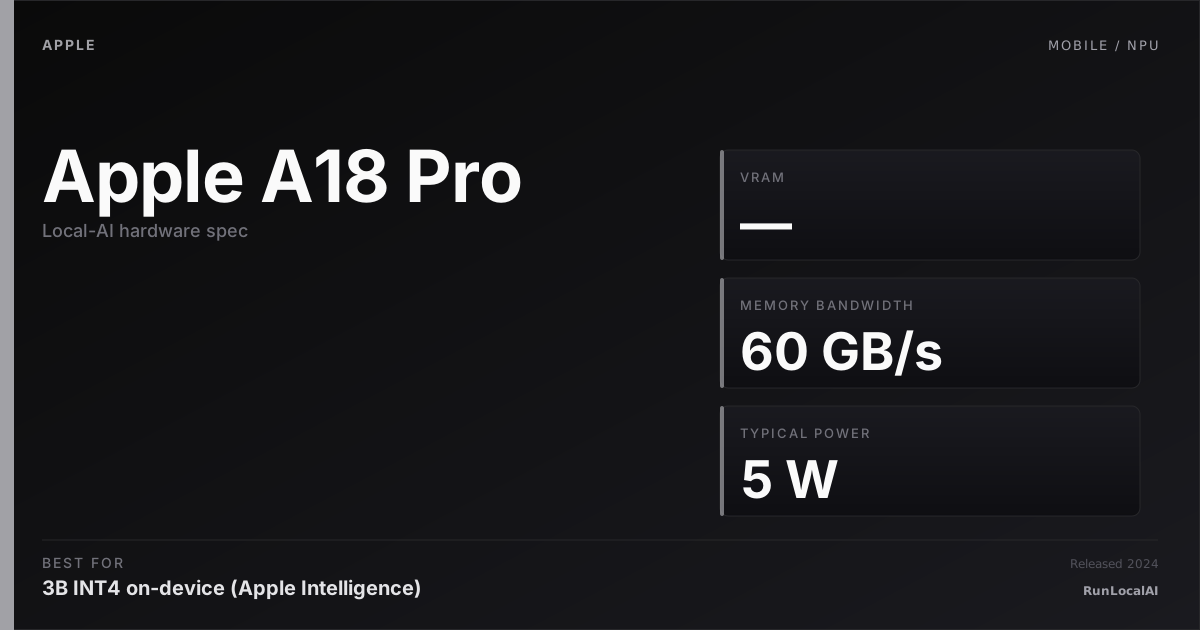
iPhone 16 Pro SoC. Improved Neural Engine for Apple Intelligence on-device workloads. 8GB RAM as the new mobile floor enables 3B-class on-device models.
Affiliate disclosure: as an Amazon Associate and partner of other retailers, we earn from qualifying purchases. The verdict on this page is our editorial opinion; affiliate links never influence what we recommend.
Sub-scores sum to 324 / 1000. Headline = 324 × 0.70 (Estimated-confidence discount) = 227. This is an algorithmic performance-tier score — distinct from, and often lower than, the editorial “Our verdict” below, which weighs value and real-world fit (especially for hardware we haven’t measured yet). How scoring works →
Extrapolated from 60 GB/s bandwidth — 8.4 tok/s estimated. No measured benchmarks yet.
Plain-English: Doesn't fit modern chat models usefully.
Verdicts extrapolated from catalog VRAM + bandwidth + ecosystem flags. Hover any chip for the rationale. Want measured numbers? Submit your own run with runlocalai-bench --submit.
Our verdict
What it does well
The Apple A18 Pro is the 2024 iPhone 16 Pro / 16 Pro Max SoC and Apple's first chip designed explicitly for Apple Intelligence on-device AI. 6 CPU cores (2 performance + 4 efficiency) + 6 GPU cores + 16-core Neural Engine + 8 GB unified memory. The chip ships in iPhone 16 Pro / 16 Pro Max at $999-$1,199 retail and is the only A-series chip with the memory + Neural Engine capacity to run Apple Intelligence on-device features. For on-device AI use cases (Apple Intelligence Writing Tools, Image Playground, Genmoji, summarization, smart reply), A18 Pro delivers genuinely useful throughput on sub-3B parameter models. Apple's MLX framework runs on iPhone 16 Pro — small but growing ecosystem of MLX-on-iOS apps lets developers run small LLMs on the phone.
Where it breaks
- iOS sandbox limits all serious AI development. No Terminal, no proper Python environment, no MLX command-line. You can run pre-packaged MLX iOS apps but you can't develop against MLX directly on iPhone.
- 8 GB memory ceiling. Limits LLM workloads to sub-3B class. Apple Intelligence's on-device model is ~3B parameters, fits comfortably.
- No CUDA, no llama.cpp Metal CLI, no real LLM tooling. iOS sandboxes apps too aggressively for real LLM development.
- Battery life under sustained AI is minutes. Phone-form thermal envelope limits sustained workloads.
- Apple Intelligence is geographically gated. Requires English (US) initially, expanding to other regions through 2025-2026.
Ideal model range
- Sweet spot: Sub-3B class on-device inference (Apple Intelligence's 3B model).
- Sweet spot: Apple Intelligence features (Writing Tools, Image Playground, Genmoji, ChatGPT integration through Siri).
- Sweet spot: iPhone-form factor + AI as feature, not the reason to buy.
- Bad fit: Anything beyond Apple's first-party AI features. iPhone is not AI development hardware.
Verdict
Buy iPhone 16 Pro / 16 Pro Max for the iPhone use case (camera, ecosystem, Apple Intelligence as feature) — the AI is a bonus, not the primary reason. For most readers, this verdict is informational reference about the silicon powering Apple Intelligence's on-device features.
Skip this if you're shopping for AI development hardware — phones aren't the right tier. Pick a Mac (any Apple Silicon) for actual local AI development.
How it compares
- vs Apple A17 Pro → A17 Pro is the iPhone 15 Pro chip with similar Neural Engine but does NOT support Apple Intelligence on-device (Apple chose to support only A18 Pro and newer). The Apple Intelligence cutoff is the meaningful upgrade reason.
- vs Apple M4 (iPad Pro) → M4 has dramatically more CPU + GPU + Neural Engine compute + 8-16 GB unified memory. iPad Pro M4 is meaningfully more capable for on-device AI. iPhone is the phone form factor.
- vs Snapdragon 8 Elite (Android) → Android-side equivalent. Different ecosystem (Apple Intelligence vs Google Gemini Nano + Samsung Galaxy AI).
- vs Google Tensor G4 (Pixel) → Google's custom SoC with deep Gemini Nano integration.
Overview
What the Apple A18 Pro actually is, in local-AI terms
The A18 Pro is the iPhone 16 Pro / 16 Pro Max chip, and as of May 2026 it is the most local-AI-capable mobile SoC in shipping consumer hardware. 8 GB of unified memory, an upgraded 16-core Neural Engine that handles Apple Intelligence's on-device features, a 6-core GPU with Apple's matmul-acceleration improvements over the A17 Pro, and a thermal envelope that lets it sustain serious inference workloads for short bursts — exactly the shape of the workloads on-device AI actually demands.
The on-device LLM behind Apple Intelligence is a small (~3B-class) model running through a custom path that uses the ANE for substantial portions of the matmul work. Third-party developers don't get the same private path, but they do get CoreML + the ExecuTorch and MLC-LLM and ONNX Runtime Mobile routes — all of which can target the A18 Pro's GPU + ANE combination.
Where it fits in the hardware ladder
The 2026 mobile-SoC AI ladder:
| Chip | RAM | NE / NPU | LLM realistic |
|---|---|---|---|
| Apple A17 Pro (iPhone 15 Pro) | 8 GB | 16-core NE | 1B-3B INT4 |
| Apple A18 Pro (iPhone 16 Pro) | 8 GB | upgraded 16-core NE | 3B-7B INT4 with care |
| Snapdragon 8 Elite (Android flagship) | 12-16 GB | Hexagon NPU | 7B INT4 |
| Apple M4 iPad | 8-16 GB | 16-core NE | 7B-13B comfortably |
The 8 GB ceiling is the binding constraint on iPhone-class hardware. A 3B INT4 model + system memory + the OS leaves very little headroom for KV-cache; 7B INT4 is technically possible but tight.
Best use cases
- Apple Intelligence on-device features. The first-party use case; all of the A18 Pro's AI silicon is sized for this.
- Third-party 1B-3B-class LLM inference. Phi-3-mini, Llama 3.2 1B / 3B, Gemma 2 2B — all real models that fit in 8 GB with workable context. See /stacks/android-on-device-ai for the cross-mobile picture.
- On-device speech recognition. Whisper-tiny / Whisper-small via CoreML or ExecuTorch — the A18 Pro is fast enough to do this real-time.
- Image generation / inpainting on-device. Smaller diffusion models (Stable Diffusion 1.5 distilled, on-device-tuned variants) run on the GPU + ANE.
- Embedding pipelines for on-device RAG. Sentence-transformers via CoreML — fits and runs fast.
What it can run
The realistic working set on a 16 Pro / 16 Pro Max in May 2026:
| Model class | Quant | Context | Notes |
|---|---|---|---|
| 1B | INT4 | 32K | comfortable |
| 3B | INT4 | 16K | comfortable |
| 7B | INT4 | 4-8K | tight but possible |
| 13B+ | — | — | does NOT fit |
Note: actual usable context is gated by KV-cache memory + the OS keeping background apps. A 3B model + 32K context + an actively used phone is not realistic; 4-8K is a more honest planning number. The right design pattern for an iOS-shipping AI app is a 3B INT4 base model + tight prompt budget + retrieval-augmented short-context inference, not a chat-history-rich long-context loop. Apps that try to keep a 32K rolling history of conversation in-process will get killed by iOS's memory pressure handler at the worst possible moment.
A second discipline that pays off on iPhone: batch the prefill, stream the decode. Prefill is the part that benefits most from the GPU + ANE; decode is bandwidth-bound. Most iOS LLM frameworks let you tune the prefill batch size separately from the decode loop — taking the time to profile and pin those values is the difference between "the app feels responsive" and "the app stutters every prompt."
OS support
| OS | Quality |
|---|---|
| iOS 18 | excellent — primary target |
| iOS 19 | excellent — recommended |
| Older iOS | unsupported on this hardware |
iPad equivalents (the M4 iPad, Apple M4 iPad) have a different but related software story — same CoreML / ANE path, more memory, more thermal headroom.
Software / runtime support
The A18 Pro's third-party local-AI ecosystem:
- CoreML + Create ML — the first-party path; the only way to fully exercise the ANE
- ExecuTorch — Meta's PyTorch-targeted on-device runtime; CoreML and MPS backends
- MLC-LLM — TVM-based mobile-LLM runtime; iOS support solid
- ONNX Runtime Mobile + CoreML EP — cross-platform path via ONNX
- llama.cpp — Metal backend works on iOS but no ANE; lower throughput than CoreML-targeted paths
- MLX-Swift — see MLX-Swift; the Swift-native MLX bindings for iOS / macOS
The Neural Engine remains addressable only through CoreML / Apple's first-party tooling. ExecuTorch and ONNX Runtime can target the ANE through CoreML as a backend, but third-party tools cannot directly schedule ANE kernels. Practically, this means: if you want ANE acceleration, your model must go through the CoreML conversion path. If you don't go through CoreML, you get the GPU + CPU path through Metal — still fast, but ~2× slower in practice on the matmul-heavy parts of small LLMs.
A useful design heuristic: pick the smallest framework that gets you to the ANE. If you only need iOS, use CoreML directly. If you need cross-platform iOS + Android shipping with shared code, use ExecuTorch with the CoreML backend on iOS and the XNNPACK backend on Android. ONNX Runtime Mobile is the right answer when you also need Windows, but the conversion overhead is real.
What breaks first
- Memory pressure. 8 GB shared with the OS + active app + background apps + the model + KV-cache is genuinely tight. iOS aggressively kills background processes when memory pressure hits the model's process.
- Thermal throttling. Sustained inference for >30-60 seconds drops clocks; the iPhone chassis is not designed for sustained AI workloads. Burst workloads are the right shape.
- CoreML conversion drift. New model architectures need CoreML converter updates; lag is typical. The HF -> CoreML pipeline via
coremltoolsis the standard path. - iOS app size limits. App Store size caps + on-demand resource limits constrain how big a bundled model can be; quant matters for shipping.
- Privacy entitlements for AI features. Some iOS APIs require explicit user consent + entitlements; plan for the App Review process.
Alternatives by intent
| If you want… | Reach for |
|---|---|
| Same chip class with more RAM | Apple M4 iPad (16 GB) |
| Android flagship equivalent | Snapdragon 8 Elite phone |
| Older iPhone | Apple A17 Pro (iPhone 15 Pro) — 1B-3B class |
| Mac counterpart | Apple M4 Max — laptop tier |
| Snapdragon laptop (NPU) | Snapdragon X Elite |
Best pairings
- CoreML-converted 3B INT4 LLM + an iOS-native chat app — the canonical on-device assistant pattern
- ExecuTorch + CoreML backend + Llama 3.2 3B INT4 — the cross-platform iOS-and-Android shipping pattern
- MLC-LLM for a TVM-tuned Phi-3-mini / Gemma 2B on iOS
- Whisper via CoreML for on-device speech
- The iPhone 16 Pro Max chassis specifically — the larger battery + better thermal headroom is a real factor for any AI workload
Who should avoid the A18 Pro (for local AI)
- Anyone who needs >7B-class models. Wrong tier; the iPhone is not the right device for that workload.
- Operators who need long-context decoding (>16K). KV-cache memory pressure on iPhone is too tight.
- Cross-platform Android-first apps. A Snapdragon 8 Elite ships sooner via the QNN path; iOS becomes the secondary target.
- Anyone targeting older iPhones (15 / 14 / 13). A17 Pro / A16 / A15 have noticeably less AI headroom; design for the lower tier or make the AI features tier-conditional.
- Heavy server-side ML developers. Wrong hardware shape entirely.
Related
- Stacks: /stacks/android-on-device-ai, /stacks/offline-rag-workstation
- System guides: /systems/quantization-formats, /setup
- Tools: ExecuTorch, MLC-LLM, ONNX Runtime
- Hardware: Snapdragon 8 Elite, Apple M4 iPad, Apple A17 Pro
Prices quoted in the review text are estimates from when it was written. Check the current price before you buy.
Some links above are affiliate links. We may earn a commission at no extra cost to you. How we make money.
Featured in this stack
The L3 execution stacks that pick this hardware as a recommended component, with the one-line note explaining the role it plays in each.
- Stack · L3·Homelab tier·Role: Target SoC (iPhone 16 Pro)iPhone on-device AI stack — Llama 3.2 3B / Phi-3.5 Mini via MLX Swift
A18 Pro 38 TOPS Neural Engine + 8GB RAM. The 8GB floor is what makes 3B-class models viable on-device — A17 Pro at 8GB also works but with tighter KV-cache headroom.
Specs
| VRAM | 0 GB |
| System RAM (typical) | 8 GB |
| Power draw (peak) | 5 W |
| Released | 2024 |
| Backends | Metal MLX |
Hardware worth comparing
The closest alternatives by price, memory bandwidth, and form factor, plus a step up and down — so you can frame the buying decision against real options.
Frequently asked
Does Apple A18 Pro support CUDA?
Where next?
Reviewed by RunLocalAI Editorial. See our editorial policy for how we research and verify hardware specifications.