Intel Arc A770 16GB
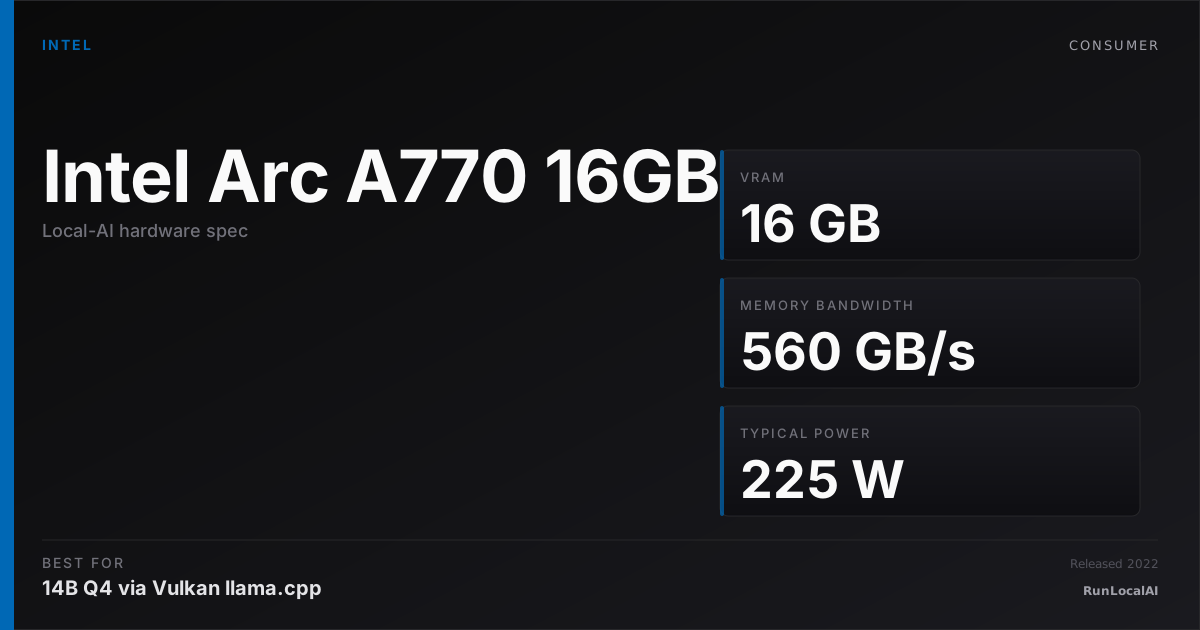
Alchemist 16GB. Cheapest path to that VRAM tier. Vulkan llama.cpp is the most-tested route.
Affiliate disclosure: as an Amazon Associate and partner of other retailers, we earn from qualifying purchases. The verdict on this page is our editorial opinion; affiliate links never influence what we recommend.
Sub-scores sum to 366 / 1000. Headline = 366 × 0.70 (Estimated-confidence discount) = 256. This is an algorithmic performance-tier score — distinct from, and often lower than, the editorial “Our verdict” below, which weighs value and real-world fit (especially for hardware we haven’t measured yet). How scoring works →
Extrapolated from 559 GB/s bandwidth — 44.7 tok/s estimated. No measured benchmarks yet.
Plain-English: Comfortable at 14B and below — snappy enough for a coding agent.
Verdicts extrapolated from catalog VRAM + bandwidth + ecosystem flags. Hover any chip for the rationale. Want measured numbers? Submit your own run with runlocalai-bench --submit.
What it does well
The Intel Arc A770 16GB is the cheapest 16 GB consumer GPU for local AI in 2026 — period. 16 GB GDDR6 at 560 GB/s + Intel Xe-HPG (Alchemist) compute at $349 retail / $250-300 used. The 16 GB VRAM ceiling at this price point is unique — no NVIDIA or AMD card matches the $/VRAM ratio at the consumer entry tier. The Intel Arc software story has matured significantly through 2024-2026: llama.cpp Vulkan + DirectML + ONNX Runtime + OpenVINO + Intel-tuned PyTorch (Intel Extension for PyTorch / IPEX) all run reasonably. Intel's IPEX-LLM project is the canonical Arc + LLM toolchain — if you target IPEX-LLM specifically, you get genuinely useful throughput on 7B–14B class models (~40-70 tok/s on 7B Q4 is realistic). For very budget-conscious buyers or vendor-diversification choices, A770 16GB is a real option that lets you run actual 14B FP16 / 32B Q4 workloads at $300 used.
Where it breaks
- No CUDA, no ROCm — Intel Arc + IPEX/OpenVINO/Vulkan ecosystem only. vLLM, SGLang, TensorRT-LLM, ExLlamaV2, most fine-tuning libraries — none run on Intel Arc. The basic local AI tooling (llama.cpp Vulkan, IPEX-LLM, Ollama with experimental Vulkan support) covers entry use cases but the long tail of NVIDIA / AMD-only frameworks doesn't.
- Day-zero new model support is the worst of the three GPU vendors. Intel Arc software for new model architectures arrives weeks-to-months after NVIDIA and often after AMD as well.
- Driver maturity is improving but real issues remain. Intel Arc drivers in 2026 are dramatically better than at 2022 launch but still occasionally surface compatibility issues with niche software, edge-case workloads, or specific gaming engines.
- Compute ceiling vs equivalent NVIDIA / AMD. Arc A770's tensor units are functional but not class-leading — for compute-bound workloads (longer context, larger batches), NVIDIA / AMD equivalents win.
- Power draw at 225 W is reasonable but not exceptional.
- Resale liquidity is thin. Intel Arc has lower secondary market volume than NVIDIA or AMD; resale pricing is irregular.
- Architecture is one generation behind. Battlemage (Arc B-series) is the current-gen Intel discrete GPU. Intel Arc B580 is the modern entry pick.
Ideal model range
- Sweet spot: 7B–13B FP16 / Q5 inference at ~30–60 tok/s decode with 32K context via IPEX-LLM.
- Sweet spot: 14B Q5 with 16K context — fits 16 GB comfortably with Vulkan or IPEX paths.
- Sweet spot: Multi-model agentic loops fitting 16 GB total — 7B + 4B + embedding model.
- Sweet spot: First-time non-CUDA local AI exploration on a tight budget — the cheapest 16 GB GPU available.
- Stretch: 32B Q4 with 8K context (25-35 tok/s; fits 16 GB tight).
- Bad fit: 70B-class anything, fine-tuning at scale, CUDA-only frameworks, day-zero new model architectures.
Bad use cases
- CUDA-locked stacks. Don't pick Intel Arc if your toolchain requires CUDA.
- Day-zero new model architectures. Intel Arc support is the slowest of the three vendors.
- Production / serious development. Pick NVIDIA for ecosystem maturity, especially for fine-tuning workflows.
- Maximum decode throughput. Equivalent-priced NVIDIA / AMD wins on raw speed.
- Anyone considering used RTX 3060 12GB. Used 3060 12GB at $200 has CUDA + similar bandwidth at the same money — for pure ecosystem, 3060 wins despite less VRAM.
- Anyone wanting current-gen Intel Arc. Pick Intel Arc B580 or higher Battlemage tiers.
Verdict
Buy this if you find an Arc A770 16GB at $250–$300, you're vendor-diversifying away from NVIDIA / AMD specifically, your toolchain targets IPEX-LLM or Vulkan-based llama.cpp, your workload is firmly 7B–14B class with occasional 32B Q4 use, and budget is the dominant priority. Arc A770 16GB is the unique "cheapest 16 GB GPU for AI" pick — and for the right buyer, it's genuinely good value.
Skip this if your stack requires CUDA (don't fight the ecosystem), you want maximum throughput, you need fine-tuning at scale (Intel weak), you target 24+ GB workloads (used 3090 wins), you want day-zero new model support (NVIDIA / AMD always faster), or you need long-horizon driver maturity (Intel still improving in 2026).
How it compares
- vs Intel Arc B580 (12 GB) → B580 is current-gen Battlemage at $249 with 25% less VRAM but architecture-current features. Pick B580 for current-gen Intel Arc; A770 16GB for the unique 16 GB at $349 / $250-300 used pricing.
- vs used RTX 3060 12GB → 3060 12GB at $200 used has full CUDA stack + similar bandwidth + 25% less VRAM at lower price. For ecosystem certainty, 3060 12GB wins. For 16 GB VRAM ceiling at the cheapest possible price, A770 16GB. See /compare/intel-arc-a770-16gb-vs-rtx-3060-12gb.
- vs RTX 4060 Ti 16GB → Same VRAM tier. 4060 Ti 16GB has CUDA + Ada-gen + ~30% less bandwidth at $429 MSRP. Pick 4060 Ti 16GB for ecosystem certainty + Ada-gen; A770 16GB for the cheaper 16 GB pick when you accept Intel ecosystem trade-offs.
- vs RX 7600 XT (16 GB) → Same VRAM tier, AMD vs Intel. RX 7600 XT at $329 MSRP has AMD ecosystem (more mature than Intel for LLM work in 2026). Pick RX 7600 XT over A770 16GB for AMD-aligned buyers; A770 16GB only when you specifically want Intel.
- vs Intel Arc A770 8GB → 8 GB variant of same chip — half the VRAM at modestly less cost. The 16 GB variant is the right pick for AI; 8 GB is a trap at this tier.
Overview
What the Intel Arc A770 16GB actually is, in local-AI terms
The Intel Arc A770 16 GB is the cheapest 16 GB GPU on the market in 2026, full stop. Sub-$270 new, occasionally lower used, with 16 GB of GDDR6 at 560 GB/s memory bandwidth and Intel's Xe-HPG (Alchemist) architecture underneath. As a gaming card it has long since been overtaken by the Battlemage generation; as a local-AI value buy, the A770 16 GB has become more interesting over the last year as the OpenVINO and llama.cpp Vulkan / SYCL paths have matured.
The trade is real: picking the A770 means living in the Intel inference ecosystem in 2026. That ecosystem has improved dramatically — OpenVINO is genuine, the SYCL backend in llama.cpp works, IPEX-LLM is actively developed — but it is still meaningfully behind CUDA and meaningfully ahead of where AMD ROCm was in 2023.
For the right operator, an A770 16 GB at $250 is a real 13B-class card. For the wrong operator, the software friction makes a used RTX 3060 12GB at the same price a better outcome.
Where it fits in the hardware ladder
In the budget 16 GB tier:
| Card | VRAM | BW | Price | Notes |
|---|---|---|---|---|
| Intel Arc A770 16GB | 16 GB | 560 GB/s | ~$250 | the value pick, Intel ecosystem |
| RTX 4060 Ti 16GB | 16 GB | 288 GB/s | ~$450 | more money, faster engines, slower BW |
| Intel Arc B580 12GB | 12 GB | 456 GB/s | ~$220 | newer Battlemage, less VRAM |
| RTX 4070 Ti Super | 16 GB | 672 GB/s | ~$830 | mid-range tier above |
vs the RTX 3060 12GB ladder slot: the A770 has more VRAM, more bandwidth, and a similar price — but trades away CUDA's mature software for Intel's still-maturing stack.
Best use cases
- Budget Linux homelab with the patience to run llama.cpp Vulkan / SYCL. This is where the A770 actually shines.
- Intel-aligned workstation. If you already have a 13th/14th-gen Intel CPU + an Intel motherboard, the driver stack is more cohesive than mixing AMD GPU + Intel CPU.
- OpenVINO-native deployment target. When you want INT4 / INT8 inference with OpenVINO's optimizer, the A770 is a first-class target.
- Cheap 16 GB for embedding-heavy RAG. Run an 8B chat model + embeddings + vector store on one card for under $300 hardware.
- Cross-platform Vulkan path testing. llama.cpp's Vulkan backend works on Intel and AMD; the A770 is the canonical Intel test target.
What it can run
| Model class | Quant | Context | Notes |
|---|---|---|---|
| 7B | F16 | 16K | comfortable |
| 7B-8B | Q5_K_M | 32K | comfortable |
| 13B-14B | Q4_K_M | 16K | works, tight on context |
| 13B-14B | Q5_K_M | 8K | tight |
| 32B | — | — | does NOT fit |
Same shape as the RTX 3060 12GB but with 33 % more VRAM, so 13B-class headroom is meaningfully better. Tokens-per-sec on llama.cpp Vulkan for an 8B Q4 model is competitive with the 3060 12 GB; on SYCL with IPEX-LLM, sometimes a bit faster.
OS support
| OS | Quality | Notes |
|---|---|---|
| Linux (Ubuntu 24.04 LTS) | good | the recommended platform |
| Linux (Arch / Fedora) | partial | distro-dependent driver packaging |
| Windows 11 native | good | OpenVINO works; Vulkan works |
| Windows (WSL2) | partial | GPU passthrough exists but is rougher |
| macOS | unsupported |
The A770's Linux experience in 2026 is markedly better than it was at launch, but still less mature than CUDA on Linux by a meaningful margin.
Software / runtime support
The honest 2026 picture:
- OpenVINO — first-class. Intel's inference compiler is the canonical A770 path.
- llama.cpp Vulkan — works well on the A770 in 2026; the most cross-platform path.
- llama.cpp SYCL — works; can be faster than Vulkan with the right build flags.
- Ollama — works via the Vulkan backend; not the project's primary target.
- IPEX-LLM — Intel's PyTorch extension; the bleeding-edge Intel inference path with int4 acceleration.
- vLLM — limited support; the A770 is not the target hardware.
- ExLlamaV2 — unsupported (CUDA-only kernels).
- TensorRT-LLM — unsupported (NVIDIA-only).
- PyTorch (Intel XPU wheels) — installs in one line; coverage less mature than CUDA.
What breaks first
- Driver / kernel mismatch on Linux. Intel's compute driver stack expects a recent kernel + recent firmware; older Ubuntu LTS variants often need the OEM driver repo.
- Bleeding-edge model architectures. New MoE routers, novel attention variants, etc., land on CUDA first; Intel paths catch up 2-6 months later, sometimes never for niche architectures.
- Multi-GPU. Intel's multi-card story for inference is meaningfully behind even AMD ROCm in 2026; pick one card and stay there.
- WSL2 GPU passthrough. Works but adds another debugging surface; native Linux is more reliable. See /errors/wsl2-gpu-not-detected.
- Reference-blower thermals. The original A770 LE has known issues under sustained AI workloads; aftermarket triple-fan designs are more reliable.
Alternatives by intent
| If you want… | Reach for |
|---|---|
| Same VRAM, NVIDIA software | RTX 4060 Ti 16 GB (~2× the price) |
| 16 GB on a budget, AMD | RX 7800 XT (similar shape, ROCm tax) |
| 12 GB cheaper, NVIDIA | RTX 3060 12GB |
| Newer Intel arch | Intel Arc B580 12 GB (Battlemage) |
| Apple-budget | base Mac mini M-series 16 GB unified |
| Mid-range upgrade | RTX 4070 Ti Super |
Best pairings
- Ubuntu 24.04 LTS + Intel compute driver + llama.cpp Vulkan — the reliable production path
- OpenVINO + 7B INT4 model — Intel-native inference with serious throughput
- Open WebUI + Ollama Vulkan — the homelab default
- AnythingLLM + 7B chat + Intel embeddings — the budget RAG setup
- A modest 600 W Bronze PSU — 225 W TDP doesn't demand premium power
Who should avoid the Intel Arc A770 16GB
- Operators who value time over money. Intel's software tax is real; if you bill at $100+/hr, the time premium often exceeds the hardware savings vs an NVIDIA equivalent.
- Anyone on a CUDA-only software stack (ExLlamaV2, TensorRT-LLM, latest vLLM features). Wrong vendor.
- Multi-GPU homelab builders. Intel's multi-card inference is not where you want to be in 2026.
- Apple-ecosystem operators. Stay with Apple Silicon.
- Workloads that need >13B-class capacity. 16 GB is too tight for 32B; jump to a 24 GB card.
Related
- System guides: /setup, /compatibility, /systems/quantization-formats
- Stacks: /stacks/offline-rag-workstation, /stacks/local-coding-agent
- Tools: OpenVINO, llama.cpp, Ollama
- Errors: /errors/wsl2-gpu-not-detected
Some links above are affiliate links. We may earn a commission at no extra cost to you. How we make money.
Specs
| VRAM | 16 GB |
| Power draw (peak) | 225 W |
| Released | 2022 |
| MSRP | $349 |
| Backends | Vulkan |
Models that fit
Open-weight models small enough to run on Intel Arc A770 16GB with usable context.
Hardware worth comparing
The closest alternatives by price, memory bandwidth, and form factor, plus a step up and down — so you can frame the buying decision against real options.
Arc A770 16 GB is the budget Intel discrete — 16 GB at sub-$300 used. The guides below frame where it fits in the entry-tier landscape.
Frequently asked
What models can Intel Arc A770 16GB run?
Does Intel Arc A770 16GB support CUDA?
How much does Intel Arc A770 16GB cost?
Where next?
Reviewed by RunLocalAI Editorial. See our editorial policy for how we research and verify hardware specifications.