AMD Radeon RX 7900 XTX
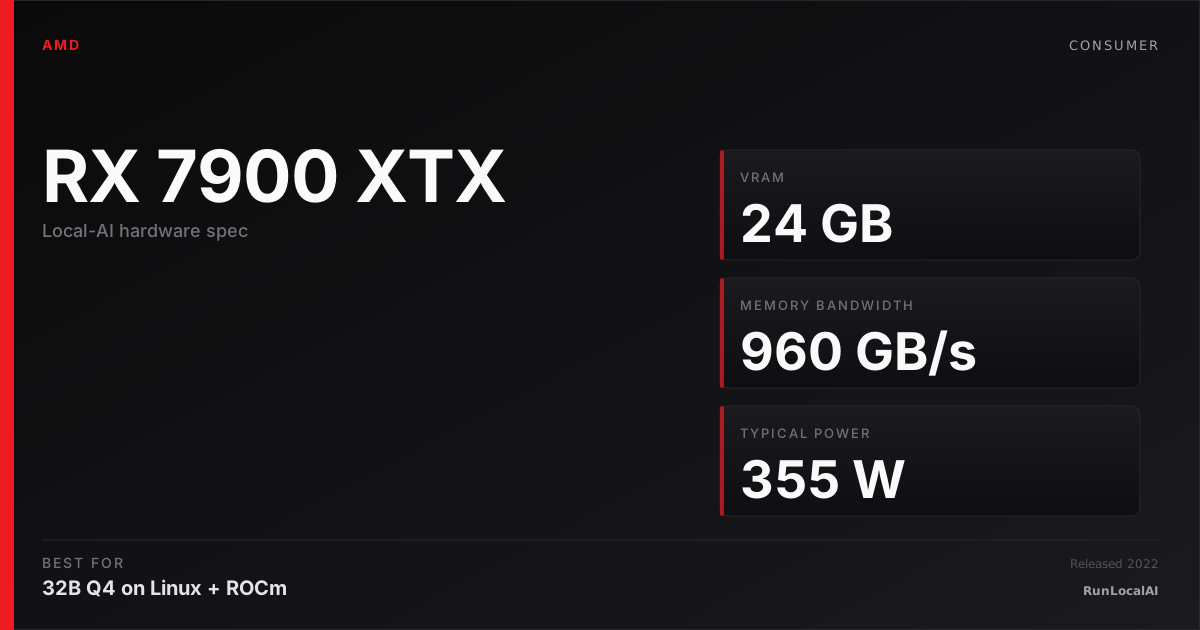
AMD's 24GB challenger to the 4090. ROCm Linux now solid for llama.cpp and vLLM. Best price-per-VRAM-GB on the new market.
Affiliate disclosure: as an Amazon Associate and partner of other retailers, we earn from qualifying purchases. The verdict on this page is our editorial opinion; affiliate links never influence what we recommend.
Sub-scores sum to 600 / 1000. Headline = 600 × 0.70 (Estimated-confidence discount) = 420. This is an algorithmic performance-tier score — distinct from, and often lower than, the editorial “Our verdict” below, which weighs value and real-world fit (especially for hardware we haven’t measured yet). How scoring works →
Extrapolated from 960 GB/s bandwidth — 96.0 tok/s estimated. No measured benchmarks yet.
Plain-English: Workable at 32B, comfortable at 14B and below — snappy enough for a coding agent.
Verdicts extrapolated from catalog VRAM + bandwidth + ecosystem flags. Hover any chip for the rationale. Want measured numbers? Submit your own run with runlocalai-bench --submit.
What it does well
24 GB VRAM at materially lower pricing than the RTX 4090, with 960 GB/s memory bandwidth that's competitive on the model class it can fit. On Linux with ROCm 6+, llama.cpp hits 60–75 tok/s on Qwen 3 32B at Q4 — within shouting distance of 4090. The card you buy when "I want to run 32B-class models locally without spending RTX 4090 money."
Where it breaks
- Windows ROCm is unreliable — llama.cpp's Vulkan path works but performance lags CUDA by 30–50% on the same model.
- vLLM and ExLlamaV2 are CUDA-first — running them on AMD requires patches or alternative backends.
- Smaller fine-tune ecosystem — every model card and tutorial assumes NVIDIA; you'll spend time translating CUDA-specific commands.
Ideal model range
- Sweet spot: Qwen 3 32B / Qwen 2.5 Coder 32B at Q4 on Linux ROCm — 60–75 tok/s, full GPU.
- Stretch: Llama 3.3 70B at Q4 with system-RAM offload — ~18–24 tok/s, slower than 4090 but workable.
- Comfortable: 14B-class models with full 32K context at >100 tok/s.
Bad use cases
- Windows-primary users — Vulkan fallback is slower and finickier than CUDA. NVIDIA wins.
- Cutting-edge runners — vLLM, ExLlamaV2 require effort to bring up cleanly on AMD.
- Multi-GPU scaling — AMD's multi-GPU story for inference is weaker than NVIDIA's.
Verdict
Buy this if you run Linux, need 24 GB VRAM, value $/VRAM, and are comfortable with the rougher software ecosystem. Skip this if you're on Windows, want the easiest setup, or rely on vLLM / ExLlamaV2.
How it compares
- vs RTX 4090 → 4090 is faster and has the cleaner software stack; 7900 XTX wins on $/VRAM by 30%+ depending on market. Pick 7900 XTX if budget-constrained AND on Linux.
- vs RTX 3090 (used) → 3090 has CUDA + 24 GB at similar used pricing; 7900 XTX is the answer when used 3090 supply is dry.
- vs Apple M3 Max → M3 Max with 64+ GB unified memory runs 70B more comfortably; 7900 XTX is faster on smaller models. Different platforms.
- vs RX 7900 XT (20 GB) → 7900 XT is the price-conscious sibling but 20 GB is awkward for 32B-class — pick XTX for the headroom.
›Why this rating
7.8/10 — the most VRAM-per-dollar card from a major vendor. 24 GB at AMD pricing makes 32B-class models accessible. Loses points specifically because ROCm is still an adventure on Windows and llama.cpp's Vulkan path leaves performance on the table vs CUDA.
Overview
What the RX 7900 XTX actually is, in local-AI terms
The Radeon RX 7900 XTX is AMD's flagship consumer GPU and the most realistic AMD entry point into local AI in 2026. 24 GB of GDDR6 at 960 GB/s memory bandwidth, RDNA3 compute architecture, and a price roughly half what a new RTX 4090 costs. On paper, it should be a no-brainer. In practice, picking it means accepting the ROCm tax — the cumulative overhead of working in a software ecosystem that is mature enough to ship serious workloads but still 1-2 minor versions behind CUDA on every leading-edge inference path.
For the right operator, the price-per-VRAM-GB win pays for the ROCm tax many times over. For the wrong operator, the ROCm tax dominates and the card sits idle. The diagonal between those two outcomes is what this page exists to clarify.
Where it fits in the hardware ladder
In the consumer-AMD tier:
| Card | VRAM | BW | Notes |
|---|---|---|---|
| RX 7800 XT | 16 GB | 624 GB/s | 13B-class ceiling |
| RX 7900 XTX | 24 GB | 960 GB/s | AMD flagship |
| RX 7900 XT | 20 GB | 800 GB/s | second-tier 7900 |
vs the comparable NVIDIA tier:
| Card | VRAM | BW | Price (mid-2026) |
|---|---|---|---|
| RX 7900 XTX | 24 GB | 960 GB/s | ~$700-900 used / new |
| RTX 3090 (used) | 24 GB | 936 GB/s | ~$700-900 |
| RTX 4090 | 24 GB | 1008 GB/s | ~$1600-2000 |
vs the 3090 specifically: same VRAM, similar memory bandwidth, similar price on the used market. The differentiator is software, not silicon.
Best use cases
- Linux-native homelab operator who values open-source GPU drivers. AMD's open driver stack vs NVIDIA's proprietary blob is a real philosophical and practical difference for this user.
- Single-user inference on 13B-32B class models with llama.cpp or Ollama. These paths are mature enough on ROCm in 2026 to be production-grade.
- Ubuntu 24.04 LTS + ROCm 6.x + GGUF Q4_K_M is the reliable, well-tested 7900 XTX local-AI configuration in May 2026. Everything outside that combination has more rough edges.
What it can run
Same VRAM ceiling as a 3090 / 4090, so the capacity is identical. The throughput is meaningfully behind on most workloads:
| Model class | Quant | Context | Notes |
|---|---|---|---|
| 7B | F16 | 32K | comfortable |
| 13B-14B | Q5_K_M | 32K | comfortable |
| 32B | Q4_K_M | 16-32K | works, ~30 % slower than 3090 |
| 70B | — | — | needs 2× 7900 XTX, multi-GPU ROCm flaky |
The 32B-class workloads that are the canonical local-AI sweet spot run on a 7900 XTX, but you should expect 20-40 % lower tokens-per-sec than an RTX 3090 on the same model in practice. On llama.cpp + GGUF, the gap narrows; on AWQ / GPTQ via PyTorch ROCm, it's wider.
OS support
| OS | Quality | Notes |
|---|---|---|
| Ubuntu 24.04 LTS | excellent | the reference platform |
| Ubuntu 22.04 LTS | excellent | well-tested |
| Other Linux | partial | distro-dependent ROCm packaging |
| Windows native | partial | improving fast; many inference paths still gated |
| Windows (WSL2) | partial | works but adds another debugging surface |
| macOS | unsupported |
If you can run Ubuntu LTS, do. The Windows-AMD-AI experience in 2026 is workable but markedly worse than Linux. See /tools/rocm for the deeper picture.
Software / runtime support
The honest, current-as-of-May-2026 picture:
- llama.cpp — excellent. HIPBLAS path is mature. The reliable 7900 XTX inference engine.
- Ollama — good on Linux, partial on Windows. Inherits llama.cpp's HIPBLAS support.
- vLLM — supported on consumer RDNA3 but rougher than CUDA path; consumer multi-GPU TP is flaky.
- SGLang — partial AMD support; lags vLLM.
- PyTorch (ROCm wheels) — installs in one line; most research code runs.
- ExLlamaV2 — limited; EXL2 kernels are CUDA-tuned.
- bitsandbytes — partial; the long pole for LoRA / QLoRA on AMD.
- TensorRT-LLM — NVIDIA-only.
What breaks first
- Wrong gfx target compiled in. The 7900 XTX is gfx1100. Building llama.cpp / PyTorch wheels for the wrong arch is a common setup failure. See /errors/rocm-device-not-found.
- ROCm version drift. Distro upgrades break ROCm; pin both
amdgpu-dkmsand ROCm userspace versions. - Multi-GPU tensor-parallel. Works on MI300X clusters, flaky on consumer 2× 7900 XTX setups in 2026. Layer-split is more reliable.
- Power and thermals. ~355 W board power; same PSU/airflow rules as 3090 / 4090. The reference design's vapor chamber design has a known hot-spot issue under sustained AI load — repaste if used.
- Bleeding-edge model architectures. New MoE routers, novel attention variants, etc., land on CUDA first; ROCm catches up 1-3 months later.
Alternatives by intent
| If you want… | Reach for |
|---|---|
| Same VRAM + same price, NVIDIA software | RTX 3090 used |
| Same VRAM, faster, NVIDIA software | RTX 4090 (~2× the price) |
| AMD datacenter | MI300X cluster (NB: out of consumer scope) |
| Apple-native | Apple M3 Ultra 192 GB unified |
| 16 GB AMD | RX 7800 XT (cheaper, lower VRAM ceiling) |
Best pairings
- Ubuntu 24.04 LTS + ROCm 6.x + llama.cpp + GGUF Q4_K_M — the reliable production path
- Ollama Linux — the same path with a friendlier UX
- Open WebUI + Ollama — the homelab chat default
- A 1000 W+ Gold PSU + good case airflow — non-negotiable
Who should avoid the RX 7900 XTX
- Operators who value time over money. The ROCm tax is real; if you bill at $100+/hr, the time premium often exceeds the hardware savings vs an NVIDIA equivalent.
- Anyone whose stack depends on CUDA-only kernels (FP8 transformer engine, EXL2, FlashAttention-3 variants, latest TensorRT-LLM features).
- Windows-only operators. Linux dual-boot is effectively part of the pricing model.
- Operators serving multi-user production with continuous batching. vLLM on consumer AMD in 2026 is workable but not the throughput tier of CUDA-equivalent hardware.
- Apple-ecosystem operators. Stay with Apple Silicon.
Related
- System guides: /setup, /compatibility, /systems/quantization-formats
- Tools: ROCm, llama.cpp, Ollama
- Errors: /errors/rocm-device-not-found, /errors/wsl2-gpu-not-detected
Some links above are affiliate links. We may earn a commission at no extra cost to you. How we make money.
est. = derived from US street × FX × VAT. obs. = real per-product snapshot.
Specs
| VRAM | 24 GB |
| Power draw (peak) | 355 W |
| Released | 2022 |
| MSRP | $999 |
| Backends | ROCm Vulkan |
Models that fit
Open-weight models small enough to run on AMD Radeon RX 7900 XTX with usable context.
Hardware worth comparing
The closest alternatives by price, memory bandwidth, and form factor, plus a step up and down — so you can frame the buying decision against real options.
Curated head-to-heads against specific cards — the buyer-decision shape that crosses VRAM bands.
The 7900 XTX gives you 24 GB ROCm at sub-$1,000 — competitive with the 4090 if you're on Linux. The guides below cover the AMD buyer decisions honestly.
Frequently asked
What models can AMD Radeon RX 7900 XTX run?
Does AMD Radeon RX 7900 XTX support CUDA?
How much does AMD Radeon RX 7900 XTX cost?
Where next?
Reviewed by RunLocalAI Editorial. See our editorial policy for how we research and verify hardware specifications.