NVIDIA GeForce RTX 5080
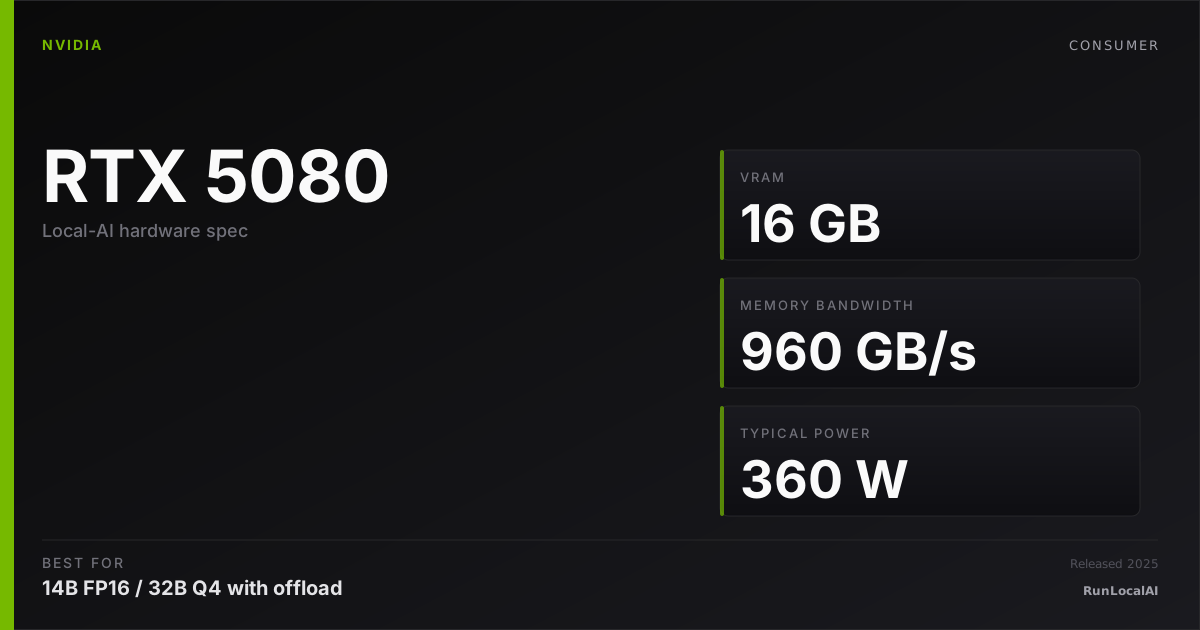
Second-tier Blackwell. 16GB GDDR7, ~960 GB/s bandwidth. Fastest 16GB consumer card on the market.
Affiliate disclosure: as an Amazon Associate and partner of other retailers, we earn from qualifying purchases. The verdict on this page is our editorial opinion; affiliate links never influence what we recommend.
Sub-scores sum to 843 / 1000. No confidence discount applied — measured data. This is an algorithmic performance-tier score — distinct from, and often lower than, the editorial “Our verdict” below, which weighs value and real-world fit (especially for hardware we haven’t measured yet). How scoring works →
Anchored to high-confidence owner measured benchmark with provenance evidence on Mistral Turkish v2 (brooqs) — 161.1 tok/s. VRAM 16GB · nvidia/enthusiast ecosystem.
Anchored to brooqs-mistral-turkish-v2-latest · 161.1 tok/s · high-confidence
Plain-English: Comfortable at 14B and below — snappy enough for a coding agent; vision models supported.
Verdicts extrapolated from catalog VRAM + bandwidth + ecosystem flags. Hover any chip for the rationale. Want measured numbers? Submit your own run with runlocalai-bench --submit.
What it does well
The RTX 5080 is the consumer card that says "I want flagship Blackwell silicon without paying RTX 5090 money." 16 GB GDDR7 at ~960 GB/s bandwidth — comparable to a RX 7900 XTX on bandwidth and slightly above a RTX 4080 Super. Decode speed for memory-bound workloads is genuinely fast at the 13B-class tier where 16 GB is the right ceiling. CUDA support is universal: vLLM, llama.cpp, Ollama, SGLang, TensorRT-LLM all run cleanly on Blackwell consumer silicon at day-zero. 360 W TDP is honest — slightly higher than the 4080 Super's 320 W but well within standard 850 W PSU territory, no dual-card bracket gymnastics required.
Where it breaks
- 16 GB caps you at 13B-class full-GPU. 32B-class models (Qwen 3 32B, Qwen 2.5 Coder 32B, QwQ 32B) need ~19-22 GB at Q4 — they don't fit fully. You partial-offload to system RAM and watch tok/s drop from 70+ to 18-25. The single-largest operational difference between the 5080 and the 5090 / 4090 24-GB tier.
- 70B-class is largely out of scope. 70B Q4 (~40 GB) means heavy partial offload, dropping tok/s to single digits. The 5080 isn't the right card for serious 70B daily-driver work.
- Pricing premium over 4080 Super at similar performance for some workloads. A 4080 Super at $999 MSRP runs the same 13B-class workloads at ~85% the speed for ~80% the price (when you can find one). For 13B-only operators the 5080 isn't dramatically better — the 5090 gap is where Blackwell's value lives.
- No FP8 like Hopper. Consumer Blackwell ships FP4 + FP8 hardware support but actual runtime support (vLLM's FP8 kernels) is uneven on consumer Blackwell as of early 2026. Datacenter Hopper paths matured first; expect consumer Blackwell to follow over 2026.
Ideal model range
- Sweet spot: 13B-class at full 32K context — Qwen 2.5 14B, Phi 4 14B, smaller Llama variants — at 80+ tok/s with comfortable headroom.
- Sweet spot (continued): 7B-class at 100+ tok/s with 128K context. Coding agents, autocomplete pipelines, anything throughput-bound.
- Stretch: 32B-class at Q4 with partial offload — slow but functional for occasional tasks. Consider 4090 (24 GB used at $1,400-1,900) if 32B-class is your daily target.
- Comfortable: 7B at 150+ tok/s, embedding models, RAG with high-throughput requirements, multi-instance serving of small models.
Bad use cases
- 70B daily-driver workloads. Wrong tier. Pick RTX 4090 (24 GB used) or RTX 5090 (32 GB new) or dual-GPU homelab.
- 32B-class daily inference. 16 GB caps the comfortable working range; partial-offload tok/s isn't acceptable for repetitive use.
- Multi-GPU rigs. Two 5080s for $2,200 give you 32 GB combined, no tensor parallelism advantage over single 5090's 32 GB at higher bandwidth.
- Anyone betting on FP8 consumer-Blackwell support landing soon. It will eventually, but if your timeline is "production by Q2 2026," verify your runtime + model combination has working consumer FP8 first. Hopper datacenter is the safer path for FP8 today.
Verdict
Buy this if 13B-class is your daily-driver target, you want flagship Blackwell silicon at sub-flagship pricing, and you're confident about 16 GB being your model ceiling for the next 2-3 years. The 5080 is the right card for "I want fast inference on the models that actually fit, not on bigger models I'd run twice a year."
Skip this if 32B-class or 70B are your daily targets (5090 or 4090 territory), if you're building a multi-GPU rig (used 3090s win on $/VRAM), or if you can find a 4080 Super at retail (similar 13B-class performance for ~$100-200 less when both are at MSRP).
How it compares
- vs RTX 5090 (32 GB) → 5090 has 2× the VRAM and ~1.9× the bandwidth at ~2.5× the price. Pick 5080 for budget + 13B-class; pick 5090 for 32B-class or 70B-class workloads. The 16-GB-vs-32-GB jump is the entire reason to step up.
- vs RTX 4080 Super (16 GB) → 4080 Super at $999 MSRP runs the same 13B-class workloads at ~85% the speed of a 5080. If you can find one at MSRP, the 4080 Super is the better $/perf pick for 13B-class. The 5080 wins only if 4080 Super is unavailable or you specifically want Blackwell silicon (FP4 future-proofing).
- vs RTX 4090 (24 GB) → 4090 has 24 GB at 1.0 TB/s bandwidth. Used 4090 at $1,400-1,900 vs new 5080 at $1,100-1,300 is the operative comparison. Pick 5080 for newer silicon + 16 GB sufficient; pick 4090 for 32B-class room + better used economics.
- vs RX 7900 XTX (24 GB) → 7900 XTX has 24 GB at $700-900 — better $/VRAM but ROCm software stack still trails CUDA. Pick 5080 for software-stack maturity + ecosystem; pick 7900 XTX for max-VRAM-per-dollar if Linux + ROCm is acceptable.
- vs RTX 5070 Ti (16 GB) → same VRAM tier, lower bandwidth, $750 MSRP. The 5070 Ti is 70-80% the 5080's performance for 75% the price. If you're price-sensitive at this tier, 5070 Ti is the better value pick. The 5080 earns its premium only on the bandwidth-driven decode delta.
Overview
What the RTX 5080 actually is, in local-AI terms
The RTX 5080 is the awkward middle child of the consumer Blackwell lineup. 16 GB of GDDR7 at ~960 GB/s memory bandwidth, full Blackwell tensor cores with FP4 acceleration, and a price that lands roughly 60-70 % of the RTX 5090. On every workload that fits in 16 GB it is genuinely fast — comfortably faster than the RTX 4080 Super and competitive with the RTX 4090 on many compute-bound paths. On every workload that doesn't fit in 16 GB it is irrelevant.
That 16 GB ceiling is the defining constraint. In 2026, the canonical local-AI sweet spot is 32B-class models at INT4. A 32B AWQ-INT4 weight-only model is ~16-18 GB before any KV-cache, so the 5080 hosts it only with painfully short context or aggressive offloading. That single fact constrains who should buy this card.
Where it fits in the hardware ladder
In the consumer-NVIDIA tier:
| Card | VRAM | BW | Bin |
|---|---|---|---|
| RTX 5070 Ti | 16 GB | 896 GB/s | mid-tier |
| RTX 5080 | 16 GB | 960 GB/s | upper-mid; 13B-class champion |
| RTX 5090 | 32 GB | 1792 GB/s | flagship |
vs the prior-gen comparable:
| Card | VRAM | BW | Notes |
|---|---|---|---|
| RTX 4080 Super | 16 GB | 736 GB/s | last-gen 16 GB |
| RTX 5080 | 16 GB | 960 GB/s | ~30 % faster on memory-bound work |
| RTX 4090 | 24 GB | 1008 GB/s | last-gen 24 GB still wins on capacity |
For pure-throughput workloads under 16 GB, the 5080 is competitive with the 4090. For anything 24 GB-bound — i.e. most of the canonical local-AI workload set in 2026 — the older 4090 is the right buy.
Best use cases
- 7B-13B class inference at high quality and high throughput. Llama 3.1 8B at FP16, Qwen 2.5 14B at AWQ-INT4 — both fit comfortably with 32K-128K context. The 5080 is fast at this tier.
- Image generation. Stable Diffusion XL and Flux at FP16 fit well in 16 GB; the 5080 is a strong image-gen card.
- Concurrent gaming + lightweight local AI. The 5080's gaming performance is its other feature; pairing a 7B chat model with a high-frame-rate gaming workload works.
- Coding-agent backend for 7B-13B coder models. DeepSeek Coder V2 16B, Qwen 2.5 Coder 14B — both real coding models that fit. See /stacks/local-coding-agent.
- FP4 experimentation on a budget. The 5080 has the same FP4 hardware as the 5090; using FP4 to fit slightly bigger models in 16 GB is a real path as engines mature.
What it can run
The realistic working set on a single 5080 in May 2026:
| Model class | Quant | Context | Notes |
|---|---|---|---|
| 7B | F16 | 64-128K | comfortable |
| 13B-14B | F16 | 32-64K | comfortable |
| 13B-14B | AWQ-INT4 | 128K | substantial headroom |
| 32B | AWQ-INT4 | 4-8K | tight; usable but not pleasant |
| 32B | AWQ-INT4 + offload | 16K | possible but slow |
| 70B | — | — | does NOT fit |
The honest answer for 32B+ at 32K context is buy a 4090 used or a 5090 new. The 5080 cannot pretend to be a 24 GB card.
OS support
| OS | Quality |
|---|---|
| Linux (Ubuntu 24.04 LTS) | excellent |
| Windows 11 native | excellent |
| Windows (WSL2) | excellent |
| macOS | unsupported |
Software / runtime support
Identical software ecosystem to the RTX 5090 — same Blackwell architecture, same CUDA generation, same tooling. Every major engine supports it:
- Ollama / llama.cpp — full GGUF support
- vLLM / SGLang — full AWQ / GPTQ / FP16 / FP8 support
- ExLlamaV2 — single-stream king on this tier
- TensorRT-LLM — supported but engineered for datacenter; using it on consumer is overkill
- LM Studio — full GUI path
- PyTorch — first-class
The FP4 software story is the same as the 5090: engines catching up through 2026.
What breaks first
- VRAM exhaustion at moderate context. A 13B-14B AWQ-INT4 + 64K context can OOM mid-generation; budget headroom explicitly.
- The "32B-shaped sales pitch." Every guide that says "32B-class is the local-AI sweet spot" is implicitly assuming 24 GB. The 5080 is one tier below; planning a stack around 32B on a 5080 will end in pain.
- Power delivery. 5080 pulls ~360 W; less brutal than the 5090 but still wants a 1000 W+ PSU.
- PCIe Gen5 x16 dependency. Older Gen4 boards work but bandwidth-limit prefill on long contexts.
- Driver / CUDA drift. Same Blackwell-era issues as the 5090.
Alternatives by intent
| If you want… | Reach for |
|---|---|
| 24 GB, slightly older | RTX 4090 used (~similar price as new 5080) |
| 32 GB | RTX 5090 — the "right" card if you can afford it |
| Cheaper 16 GB | RTX 5070 Ti or RTX 4070 Ti Super |
| AMD 16 GB equivalent | RX 9070 — much cheaper, ROCm tax |
| Apple equivalent at this tier | Apple M4 Pro — different stack entirely |
Best pairings
- Ollama + 13B Q4_K_M — the canonical solo-user setup at this tier
- ExLlamaV2 + 13B EXL2 5bpw — the single-stream throughput king setup
- Stable Diffusion XL + Flux — the image-gen sweet spot
- Continue.dev + 14B coder model — the IDE coding agent setup
- A 1000 W Gold PSU + good airflow — the standard recipe
Who should avoid the RTX 5080
- Anyone planning to run 32B-class models. The 16 GB ceiling is the wrong tool. Buy a used 4090 or new 5090 instead.
- Operators who would benefit from FP4 specifically. The 5080 has the hardware but the practical wins on 7B-13B class are smaller than on 70B-at-FP4 (where the 5080 doesn't fit anyway).
- Apple-ecosystem operators. Different stack.
- Operators on a budget who need 16 GB. The 5070 Ti and 4070 Ti Super are meaningfully cheaper at near-equivalent capability.
- 70B operators. Wrong tier.
Related
- Stacks: /stacks/local-coding-agent, /stacks/offline-rag-workstation
- System guides: /systems/quantization-formats, /setup
- Tools: vLLM, Ollama, ExLlamaV2
- Errors: /errors/wsl2-gpu-not-detected
Some links above are affiliate links. We may earn a commission at no extra cost to you. How we make money.
Specs
| VRAM | 16 GB |
| Power draw (peak) | 360 W |
| Released | 2025 |
| MSRP | $999 |
| Backends | CUDA Vulkan |
Benchmarks on this unit
Real measurements on NVIDIA GeForce RTX 5080. Numbers ship with the runner version, quant, and date so you can reproduce them.
| Model | Provenance | Quant | Ctx | Tokens / sec | TTFT | Date |
|---|---|---|---|---|---|---|
| Kumru 2B | EditorialM | Q4_K_M | 2K | 443.7tok/s | — | May 28, 26 |
| Mistral Turkish v2 (brooqs) | EditorialM | Q4_0 | 2K | 161.1tok/s | — | May 28, 26 |
| Turkcell LLM 7B v1 | EditorialM | Q4_K_M | 2K | 145.1tok/s | — | May 28, 26 |
| Llama 3.1 8B Instruct | EditorialM | Q4_K_M | 4K | 135.6tok/s | 130 ms | May 28, 26 |
| RefinedNeuro RN TR R1 | EditorialM | Q4_K_M | 2K | 133.6tok/s | — | May 28, 26 |
| RefinedNeuro RN TR R2 | EditorialM | Q4_K_M | 2K | 133.4tok/s | — | May 28, 26 |
| Malhajar Mistral 7B Turkish | EditorialM | Q5_K_M | 2K | 130.4tok/s | — | May 28, 26 |
| YTU Turkish Gemma 9B v0.1 | EditorialM | Q4_K_M | 2K | 101.1tok/s | — | May 28, 26 |
| Trendyol LLM Asure 12B | EditorialM | Q4_K_M | 4K | 82.0tok/s | 136 ms | May 28, 26 |
| Trendyol LLM Asure 12B | EditorialM | unknown | 2K | 79.1tok/s | — | May 28, 26 |
| Qwen 2.5 Coder 14B Instruct | EditorialM | Q4_K_M | 4K | 79.0tok/s | 117 ms | May 28, 26 |
| Trendyol LLM Asure 12B | EditorialM | Q4_K_M | 8K | 61.5tok/s | 323 ms | May 27, 26 |
Models that fit
Open-weight models small enough to run on NVIDIA GeForce RTX 5080 with usable context.
Hardware worth comparing
The closest alternatives by price, memory bandwidth, and form factor, plus a step up and down — so you can frame the buying decision against real options.
Curated head-to-heads against specific cards — the buyer-decision shape that crosses VRAM bands.
Frequently asked
What models can NVIDIA GeForce RTX 5080 run?
Does NVIDIA GeForce RTX 5080 support CUDA?
How much does NVIDIA GeForce RTX 5080 cost?
Where next?
Reviewed by RunLocalAI Editorial. See our editorial policy for how we research and verify hardware specifications.